Our game, Stranded, is a 3D walking simulator, where a protagonist is stranded in a desert/canyon environment and must find their way to water. For this game, we wanted to go with a reality-subversion theme, where opposites are true; to get to the water, the player must climb on and jump inside of a volcano, where there is an underground oasis. When the player meets cute foxes, they pursue you and kill you if they get too close, while snakes are harmless and only follow you around out of affection. We also wanted to give the player a sense of both being lost and timelessness, where there is no clear-cut goal to attain with a clear path to it.
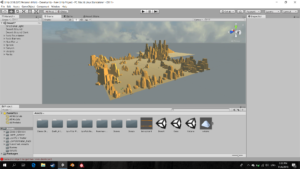
To implement the game, we divided the job into two different tasks; designing the level, and creating the main character interactions. For the first part of design of the level, we used a desert Low-Poly Pack that included assets such as rocks, plants, and palm trees. We distributed the assets throughout the environment creating an explorable desert. We didn’t want to add a clear path for the player to follow because we wanted the player to explore around and actually experience the feeling of being trapped in a vast and interminable desert in. The only thing that we did put in were the boundaries, so the player wouldn’t just wander into a free fall. For the second part of the design, we 3D modeled a volcano in Blender and gave it texture in Unity. This is the contradictory part where we wanted the player to jump inside without really knowing what would happen. For the third part, we created an oasis inside the volcano. Here, the player can wander as long as he or she desires, without the possibility of exiting it or ending the game.
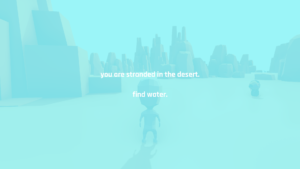
As for the interactions, we used assets taken from the Low-Poly pack, as well as Pokémon models from the games Pokémon Sun & Moon and Pokémon Ranch. This part consisted of writing and assigning scripts to models taken from different sources; the player model, which needed scripts for walking, jumping, losing health, and dying, the fox model, which needed scripts for following the player and attacking, and the snake model, which needed scripts for following the player and having heart shapes appear around its head when close to the player. We also had to create a death screen that restarted the game, a message at the beginning that briefly explains the premise (“you are lost in the desert. find water.”) and background and footstep sounds.
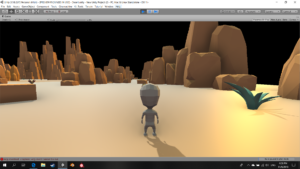
We believe that we were successful at not forcing the players to follow a specific path. The two people that tried our game did so in two very different ways; while one of them immediately started to look for the oasis and focus on it, the other one preferred to wander around the desert area and try to climb rocks everywhere. However, we did make a few changes thanks to a few concerns raised during the test. The first one was that it wasn’t too hard to climb the rocks on the boundaries of the space we created and wander off, so we made it so that the player would die and respawn if they get too far. The players also had issues with finding the oasis when they did decided to look for it, so we made the path there a little clearer by concentrating enemies at the entry of the valley leading up to it.
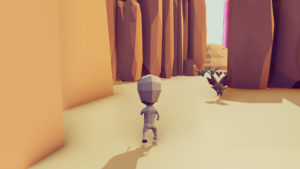
We were also successful at allowing players to wander but still have a degree of challenge in the game. When we initially play tested the game, we didn’t have any enemies on the environment, so players could walk around calmly. However, now that there are enemies that can follow and kill the character, players will still explore but be tense. The way they should feel when stranded at a desert. When we were play testing ourselves, we were able to see that the enemies were not as fast and not positioned in the best locations to surprise the player. Therefore, we decided to increase the difficulty by increasing speed and changing their positions.
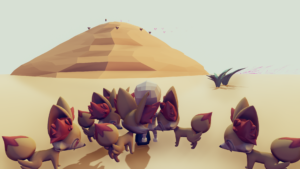
Stranded is a game that is capable of conveying narrative. There is an element of solitude and survival as one walks through the space. The landscape was carefully chosen and curated to emulate the experience of a desertic region. The obstacles did not immediately destruct the gameplay, but in maintaining a consistency to reality they hindered a player’s progress to an eventual halt. One encounters obstacles, foxes, that seek to harm the player and impede him from getting water. Amongst those, there were elements of neutrality in the form of snakes which could serve the dual purpose of protecting the player from foxes or obstructing the path to the oasis. The animals simply added to the context of the space to make the player feel even more part of the environment.
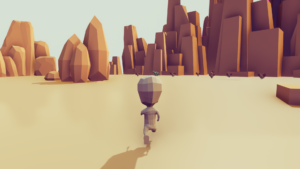
The only instruction that the player ever receives is “to find water”, which allows free wandering across the desert, the canyon, and the oasis. Once the player reaches the oasis, there is no win scenario. The player has found water and survived, but life still goes on. The character will be stuck inside the volcano having completed the task, but unable to get out. The interesting part is that player can play the game for as long as he or she wishes with no end, but the fate of the character will always be unknown. How long will they play, we do not know. But we are hoping to find out. Our emulation of reality adds to the narrative of the game.
File (Windows): https://drive.google.com/open?id=1RTKJhs279ssocIIDERKLHD1R7PPhRsh9
File (MAC): https://drive.google.com/open?id=1C64jNIztTEj2CQ_H-20w3GacN8Gg_WMT
-Hatim and Arantza